Bluetooth LE
The chip datasheet lists BLE 5.3 operation in the 2,400–2,483.5 MHz band.

Start exploring with a small board
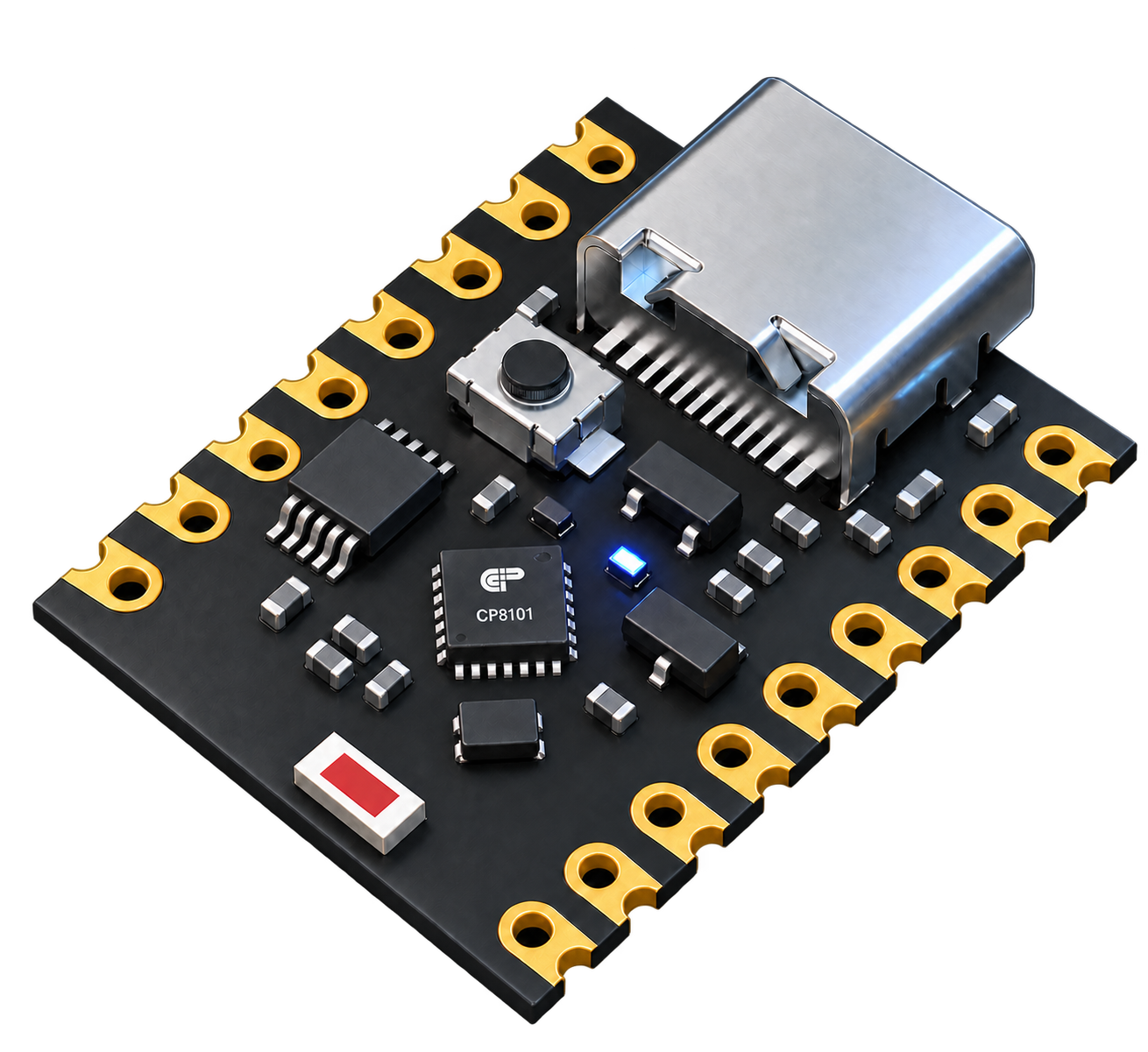
The CP8101 datasheet lists Bluetooth LE 5.3 as a chip capability, offering a starting point for 2.4 GHz connectivity and low-power designs.
The chip datasheet lists BLE 5.3 operation in the 2,400–2,483.5 MHz band.
The datasheet also lists 500 / 125 kbps; available modes and throughput depend on firmware and conditions.
It also lists 10 μA to maintain a BLE connection at a 1 s interval. Neither value is board current.
Optional Bluetooth 5.3 mechanisms such as connection subrating and channel classification are not individually confirmed by the CP8101 datasheet. CP81-MINI antenna, firmware and real power use still need validation. About the Bluetooth 5.3 specification
Connect CP81-MINI to your computer with a data-capable USB-C cable, select the detected serial port, and begin the Arduino development and serial-monitor workflow.
Use a data-capable cable with the board's USB Type-C port.
Choose the new port in Arduino IDE; Windows presents a COM port.
Choose the board package and follow the SDK serial-monitor or upload steps.
A connected Mac detected USB Serial (VID_1A86/PID_7523) and a serial port. Data transfer and uploading on the current board have not yet been tested. If Windows does not install the driver automatically, use the official WCH CH340/CH341 driver page in Downloads.
Explore CP8101 chip information, external PIN I/O and STEP model references for CP81-MINI. Board-level functions still await validation.
Explore resourcesChip facts come from CP8101 Datasheet v1.0.4; board headers from PDF V1.0.2 and model outline from STEP V1.0.3. Chip capability is not board acceptance. Board hero images are STEP-derived illustrations; the second slide's chip and third slide's peripherals are AI visualizations, not product photographs, wiring or package pin references.